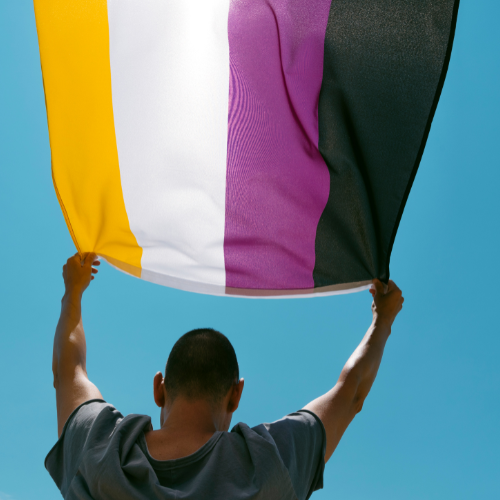
A person proudly raises the non-binary flag on a clear summer day—honouring visibility, identity, and inclusion on International Non-Binary People’s Day.
Every July 14, International Non-Binary People’s Day offers an opportunity to raise awareness, celebrate diversity, and advocate for inclusion.
This date falls precisely between International Women’s Day and International Men’s Day, symbolizing the identity and experiences of those who don’t fit within the traditional gender binary. As Canada continues to embrace diversity in all its forms, workplaces have an important role to play in creating environments where non-binary individuals can thrive.
Understanding Non-Binary Identity
Non-binary is an umbrella term for gender identities that don’t align exclusively with “man” or “woman.” People who are non-binary may feel like both genders, neither, or may move between genders. Some might use terms like genderqueer, agender, bigender, or genderfluid. It’s also important to note that non-binary people may or may not transition or use medical interventions.
In Canada, non-binary recognition is growing. Many provinces now allow for an “X” gender marker on official documents, and national surveys have started collecting more inclusive data. Still, societal understanding often lags behind, particularly in the workplace.
Why This Day Matters
International Non-Binary People’s Day isn’t just symbolic; it’s a reminder that visibility matters. Non-binary individuals often experience higher rates of discrimination, misgendering, and exclusion, especially at work. According to a 2022 report by Egale Canada, around two-thirds of non-binary people have faced barriers to employment, and nearly half feel unsafe being out at work.
Creating awareness around July 14 is a small but impactful step toward acknowledging these experiences and committing to change. It signals that non-binary employees are seen, respected, and valued.
Fostering Inclusivity at Work
Workplace inclusivity isn’t just good ethics, it’s smart business. Diverse teams, including non-binary individuals, bring unique perspectives that foster innovation, resilience, and engagement. When people feel safe, respected, and able to be themselves, they contribute more fully offering fresh ideas and different ways of thinking that strengthen the whole team.
Organizations can foster inclusion for non-binary employees in a variety of meaningful ways, from everyday practices to structural changes. Simple, meaningful ways to support non-binary colleagues and friends can start with everyday actions, such as:
- Normalize pronoun sharing
- Use inclusive language
- Support inclusive spaces
- Give feedback that matters
- Speak up and stand by
- Keep learning
Adding your pronouns to your email signature, Zoom/Teams display name, or when introducing yourself helps make it routine, not remarkable, when someone uses they/them or neopronouns like xe/xem or ze/hir. It signals that you’re open and respectful of gender diversity.
Swap “ladies and gentlemen” for “everyone” or “folks.” Avoid assumptions about someone’s gender based on appearance or name. If you’re unsure of someone’s pronouns, it’s okay to politely ask, or just use their name until you know.
You may not control what facilities are available, but you can help normalize the use of all-gender restrooms and speak up if someone is being questioned or excluded for using them.
When filling out workplace surveys or giving feedback, advocate for inclusive practices - such as adding non-binary options on forms or asking for DEI training that includes gender diversity.
If you hear misgendering or jokes at someone’s expense, offer a gentle correction or support privately, depending on what feels safe. Your voice matters - even quiet allyship can shift culture.
No one gets it perfect all the time. What matters is staying open, learning from mistakes, and continuing to grow as an ally.
Voices That Matter: A Canadian Perspective
Riley, a non-binary marketing professional in Vancouver, shared this:
"I’ve had jobs where I felt like I had to ‘pick a side’ just to fit in. It wasn’t until I worked with people who respected my pronouns and made space for me to just be myself that I finally felt like I could do my best work."
Stories like Riley’s remind us that inclusion doesn’t require a policy manual; it starts with everyday actions. Respecting someone’s identity, listening without judgment, and making space for difference can have a powerful impact. Progress happens in the small moments between colleagues.
Taking the First Step
You don’t need to be an expert in gender identity to be a thoughtful ally. It starts with curiosity, openness, and a willingness to learn and grow. Inclusivity isn’t a fixed goal; it’s something we practice every day.
This July 14, take a moment to reflect: Am I, as a colleague, helping to create a space where everyone - regardless of gender identity - feels seen, respected, and able to belong? Even small steps can make a meaningful difference.
When we celebrate and support non-binary people, we’re not just making workplaces better for them, we’re making them better for everyone.
All material copyright MediResource Inc. 1996 – 2025. Terms and conditions of use. The contents herein are for informational purposes only. Always seek the advice of your physician or other qualified health provider with any questions you may have regarding a medical condition. Source: www.medbroadcast.com/healthfeature/gethealthfeature/Creating-Inclusive-Workplaces-Recognizing-International-Non-Binary-Peoples-Day-July-14